

Is it a must to take supplements during pregnancy? Are they necessary?
By: Kaitlin Spano M.Ed, PPCES
I am not a doctor and all opinions shared are my own and for informational purposes
YES! Adding certain supplements during pregnancy is recommended by the American College of Obstetrics and Gynecology (ACOG).
While optimal nutrition during pregnancy would ideally come from a diet diverse in whole foods, the reality is that meeting increased nutrient demands through food and diet alone is exceptionally difficult, and for many women, practically impossible.
During pregnancy, requirements for key nutrients increase, with some nutrients like choline requiring nearly double the pre-pregnancy intake! Research consistently shows that even in developed countries with access to abundant food, pregnant women struggle to meet these elevated needs through diet alone; which is why proper supplementation is highly encouraged.
The challenge intensifies during the first trimester, when occasional nausea, vomiting, and food aversions affect up to 80% of pregnancies. During this critical period of fetal development, when neural tube formation and organ development are occurring, many women struggle to consume enough nutrient-dense foods.
This is why supplementation isn’t just helpful, it’s evidence-based medicine. The use of targeted nutrients during pregnancy has roots in both historical practice and clinical research.
Folate supplementation alone has reduced neural tube defects by 70% since its recommendation became widespread. Similarly, adequate iron, iodine, and omega-3 supplementation have demonstrated measurable improvements in both maternal and infant health outcomes.
The reality of maternal nutrient depletion is well-documented in scientific literature. Studies show that even women taking standard prenatal vitamins often remain insufficient in multiple critical nutrients, including vitamin D, choline, omega-3 fatty acids, and magnesium.
Research published in Nutrients (2018) found that women following their healthcare provider’s prenatal vitamin recommendations still showed deficiencies in key nutrients postpartum.
This depletion doesn’t resolve immediately after birth, it compounds with each pregnancy and can continue through breastfeeding when nutrient demands remain elevated. (I am living proof of this, I suffered severe depletion from inadequate supplementation & back to back pregnancies)
Maternal depletion manifests in multiple ways: occasional fatigue that doesn’t improve with rest, cognitive changes often dismissed as “mom brain,’ or ‘brain fog”, hair loss beyond normal postpartum shedding, mood changes, decreased stress resilience, and prolonged recovery time.
These aren’t inevitable consequences of motherhood, they’re signs of nutritional insufficiency that can be addressed.
The most effective strategy combines comprehensive supplementation starting preconception, continuing through pregnancy and postpartum, alongside a nutrient-dense whole foods diet. This approach doesn’t suggest supplementation replaces good nutrition; rather, it acknowledges that pregnancy creates nutritional demands that exceed what most women can reasonably achieve through food alone, particularly during vulnerable periods like early pregnancy when intake is compromised.

What nutrients play a vital role during pregnancy for mom and baby?
There are many nutrients that play a vital role for mom and baby, I listed a few below as Needed provides the most optimal amounts and forms that are specifically needed for the expectant mother. Listed below are some of the nutrients:
- Vitamin A: Look for a prenatal that provides preformed vitamin A (retinyl palmitate or retinyl acetate) alongside beta-carotene. Many prenatals contain only beta-carotene, which converts poorly to active vitamin A. Preformed vitamin A is essential for fetal organ development, immune function, vision development, and placental health. The dose should provide adequate vitamin A while staying well below the upper limit of 10,000 IU daily to ensure safety.
- Vitamin C: Vitamin C is needed to support mama in pregnancy and postpartum for healthy immune function, collagen synthesis, antioxidant protection, and iron absorption.
- Vitamin D: Vitamin D3 is technically not a vitamin, but a prohormone. Prohormones are the building blocks of fully formed hormones. Our skin produces Vitamin D3 when it is exposed to sunlight. But, most mamas don’t get enough sun and Vitamin D (especially those of us in cold climates) and it is difficult to get from food. Many women also contain a genetic variation that predispose them to lower levels of Vitamin D. Vitamin D3 is more readily used by the body than Vitamin D2. Vitamin D supports healthy blood pressure, forming bones and teeth for babies, and respiratory function.
- Choline: The majority of over the counter prenatals do not contain Choline. You want to look for one that includes at least 200 mg. Choline supports normal liver function, efficient uptake of Omega-3 DHA, normal neural tube development, and optimal brain development.
- Folate: the most common nutrient found in prenatals as it plays a role in neural tube development. Look for one that uses methylfolate over folic acid, as many women cannot effectively utilize folic acid, which needs multiple metabolic steps to convert it into its active form – methylfolate.
- B-Vitamins: To include B12, B6, B3 and B2. You want a supplement that includes multiple B-vitamins, not just folate. B vitamins support numerous systems, including neurological development, metabolism, and mood.
What To Look For In a Prenatal Vitamin?
Now that you know which vitamins are essential to add more of during pregnancy, the hard part is finding what products are best and which one will fit YOU best, because the market is saturated! Most over the counter prenatals provide the bare minimum, based on outdated RDA data, and offer less than ideal forms and amounts.
Would you believe that pregnant and breastfeeding women were excluded from 83% of studies that informed the RDAs? Shocking right? And these were designed to avoid deficiency, not created with optimal health, let alone optimal health across the Motherspan (preconception through postpartum and into perimenopause)!
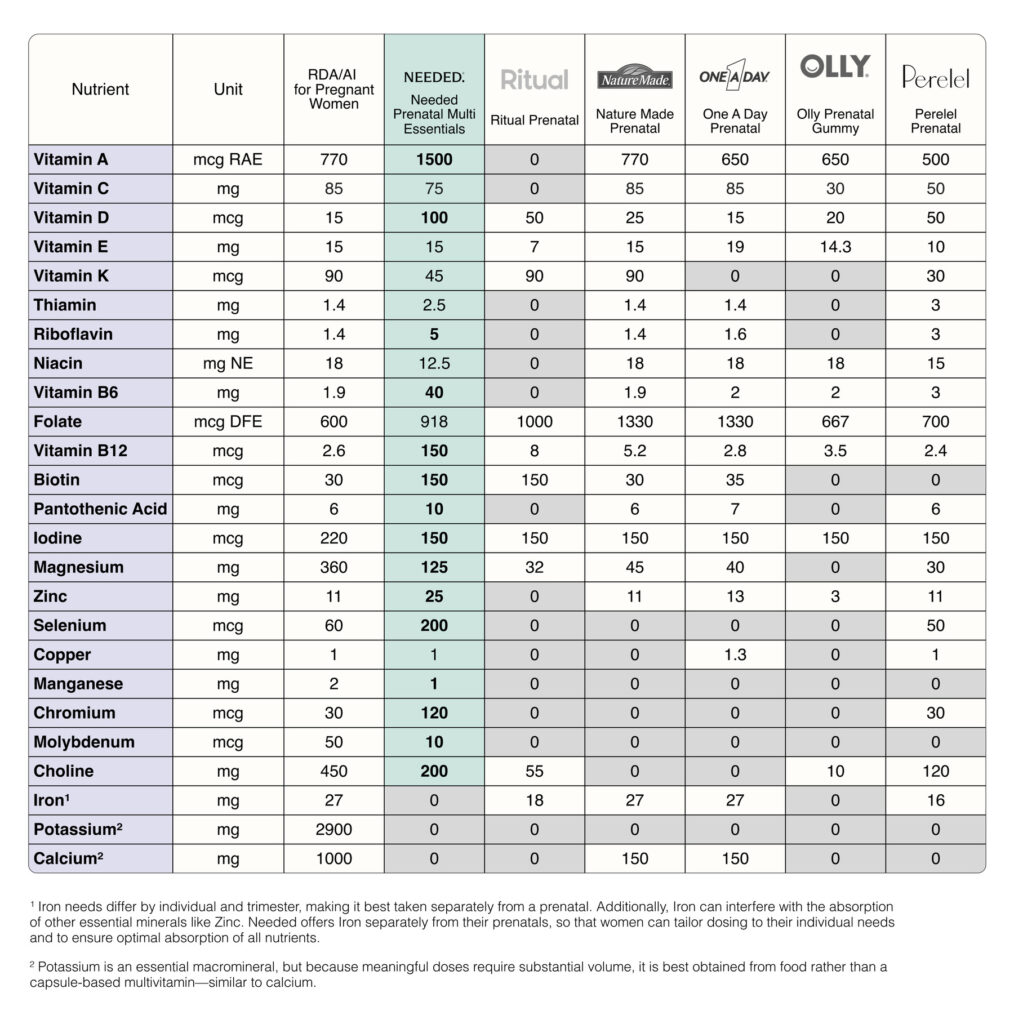
You also want to make sure the company is third party tested for quality and purity and uses proper amounts for the motherspan. The one I personally recommended and took myself in the last two of my five pregnancies is NEEDED Prenatal Multi. Their newly formulated version provides 8x more nutrition than leading prenatals.*
What I love and truly admire about Needed Prenatal Multi is that it is formulated by two mothers and backed by 15k practitioners! So they GET IT. Needed Prenatal is formulated to fight against the depletion that 95% of mothers face.
Needed Prenatal Multi includes nutrients that many prenatals leave out including, Choline, Vitamin A, B12, Selenium, and Vitamin D. They consider the entire continuum from before conception, pregnancy, breastfeeding/postpartum and beyond.

Can you continue to take prenatal vitamins after giving birth?
YES! You should absolutely take your prenatal vitamins after birth, ESPECIALLY if you are breastfeeding your baby.
Your nutritional needs are going to increase during the postpartum period because your baby is going to continue to demand more food from you, so don’t stop taking your prenatal after you have your baby.
In Conclusion:
Overall, it is essential that you consider supplementing during pregnancy; it is even better to start before you try to conceive. With the research stating that 95% of women are depleted even WHILE taking a prenatal, it is paramount that you find one that will fulfill your needs to overcome depletion during this very demanding time. You want to find a supplement that is third party tested for purity and that focuses on optimal amounts specifically for the pregnant/postpartum mother.
Needed Prenatal Multi provides all of this, here is a chart that compares other leading brands with Needed:
I hope this information helps you make an informative decision based on your needs and preferences. Best of luck momma, cheering for you! XO
This post is in partnership with Needed, a brand I genuinely recommend to my patients and use personally.
These statements have not been evaluated by the Food and Drug Administration. This product is not intended to diagnose, treat, cure, or prevent any disease.
*Based on the total daily dosage of nutrients provided compared to leading prenatals as determined by IRI sales data as of December, 2025.
RESOURCES:
- For the NHANES data on common deficiencies: https://pubmed.ncbi.nlm.nih.gov/31225890/
- For the statistics on pregnant/nursing women excluded from the research:
https://www.science.org/doi/10.1126/sciadv.abj8016
- ACOG: Healthy Eating During Pregnancy: https://www.acog.org/womens-health/faqs/healthy-eating-during-pregnancy
Leave a Reply