
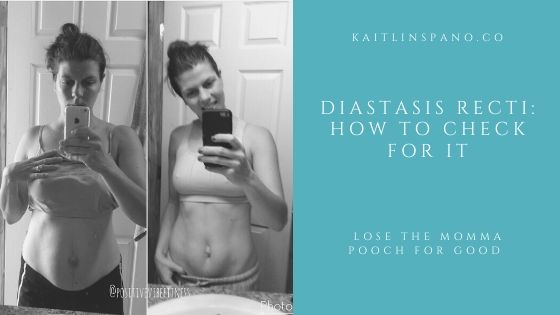

Diastasis Recti: What it is, How to prevent it & How to check yourself for it.
(Check out my YouTube Video Where I share all the deets!)
Today in my post I want to share all the knowledge of what exactly Diastasis Recti is; how to prevent it and/or heal it and how to check and see if you have it.
I personally suffered from Diastasis Recti (also known as D.R) after my first was born; but I didn’t know I HAD it! And I continued to do exercises that were harmful and after my third was born, I was REALLY suffering. My hope is that this post will help you prevent all those things! HOW did I realize I suffered from this?! Because I spent a lot of time researching and reading! I suffered from constant low back pain, I could feel my intenstine coming out through my belly button and I would even leak when I tried running, jumping or laughed real hard.
What is diastasis recti (DR)?
Diastasis Recti, or Diastasis Recti Abdominus or abdominal separation is the separation of the rectus muscles. The majority of cases present from women who have given birth to a child however you do not have to have had a baby to suffer from DR.
Research states that 66% of childbearing women will have an abdominal separation that does not heal after the initial 8 week postpartum period.
Research also states that 100% of all childbearing women will present with a abdominal separation after childbirth. It is after the 8 week period, that if the gap has not healed on it is own, one must begin a specific healing process in order to retain a functional core unit.
 Normal rectus vs a rectus present with a separation
How do you fix a separated stomach muscle?
Two things to fix a separated stomach muscle is to understand that just ‘fixing’ the separation will not work. You must first adapt a few things in your everyday movements such as your breathing and your posture. These are the very first and crucial two steps one must begin in order to start repairing the abdominal separation. The separation did not appear overnight; and unfortunately it will not be an overnight fix.
The first step in fixing your diastasis is to breath properly. You need to find, feel and re-connect with your core unit and pelvic floor. Read this post about Diaphragmatic breathing.
Once you have connected to your breath, you can beging to engage the muscles in gentle, rehabbing/restoration type movements leading with your breath.
2. Once your mind/body connection is there and restoration is feeling strong you want to work on restrengthening. Only then and ONLY then should you move onto more intense exercise. It is best to avoid any sort of sit-up, crunch or plank variation of movement during this time.
3. You want to focus on your posture. Stand, sit and walk in alignment, keeping a neutral pelvis in order to reduce intra-abdominal pressure and don’t tuck your butt or push out your chest! Read this Blog for proper alignment visuals.
Will Diastasis Recti Fix Itself?
No, it cannot fix itself, BUT Diastasis CAN be corrected, and it does not HAVE to be surgery. Each case is so different but the first thing to understand is that Diastasis Recti is a whole body issue. If you suffer from Diastasis review the 3 steps I discussed above in ways to start healing your separation.

Various degree of separation
How to check if I have a Diastasis?
You can check your DR by yourself; or you can go see a women’s physical therapist to check for you. Or you could do both.
If you are checking it yourself here are the simple steps!
- Lie down on your back, raise up your knees, feet flat on floor.
- As you go into a small crunch use your one hand to feel with your index, middle and ring finger down the middle of your abdomen. Start from your belly button and go up.
- Repeat but go from belly button down towards your pelvis.
- Your muscles will close in..how many fingers-width is ‘the gap?”
Watch this video for a hands on DR Check. You may feel the largest separation around your belly button and that is common. If you have more than 2.5 to a 3 finger width you have a Diastasis that needs focused support.
Having a 2/2.5 finger gab up to 8 weeks postpartum is considered normal. It is what happens after this 8 week period that you may need to do more intense intervention. Always check with a therapist for best results.
How can I prevent diastasis recti?
Diastasis Recti can be prevented by breathing through your diaphragm and controlling your intra-abdominal pressure.
I always say that postpartum healing begins during pregnancy! During pregnancy it is extremely beneficial to learn how to use your core unit to control your intra-abdominal pressure so that your changes of having a large separation are minimal. Of course, in order to allow for baby to grow, every pregnant woman will experience some degree of separation. Not all pregnancies result in a diastasis.
It comes down to how connected you are to your core unit and how strong the fascia is down the middle of your rectus. The strength of fascia is all dependent on how strong and connected you are to your core unit. This all begins with a knowledge of how to breathe, understanding how to control your intra-abdominal pressure and understanding what movements you do safely and which ones are not safe.
In order to prevent a larger than normal diastasis one must be aware of their everyday posture, along with proper functional movements. If you are doing a plank lets say, and you see a weird coning or doming down the middle of your core; stop. This would be unsafe as you are not properly connected to your core.
Can you heal Diastasis Recti while pregnant?
This ties in with the question above. It is dependent if you went into your current pregnancy with a separation and how large it was.
The big picture to look at in healing a Diastasis during pregnancy is to again, control your intra-abdominal pressure and focus on proper functional movements and posture. If you are conscious of how to do this and not contort your body into inappropriate positions your body will maintain a strong core connection and continue to build strong fascia.
In Conclusion:
Diastasis Recti, or Diastasis Recti Abdominus or abdominal separation is the separation of the rectus muscles. The majority of cases present from women who have given birth to a child however; you do not have to have had a baby to suffer from DR.
In order to prevent and heal your Diastasis one must understand how to connect to your deep core and create mind+muscle+body connections.
Related Posts:
Leave a Reply