

THE GUIDE TO POSTPARTUM EXERCISE:
Exercise after baby, when to start, what to do, what is safe and what is not! Before I go any further I want to share with you that this is not your typical post about postpartum exercise. I am not going to tell you that you can start working out when your doctor gives your the go ahead.
I am not going to tell you when you need to start working out or what exercises to do after baby because it is SO DIFFERENT for everyone.
INSTEAD I’m going to inform you of what rehabilitation looks like after a baby; so that you can begin to exercise after baby again with confidence and an understanding of when your body is ready for it.
You can download your Postpartum Checklist and get started with healing today.
HOW SOON CAN I WORKOUT AFTER BABY?
Every active mother wants to know when can she workout after she has had a baby. I hate to say it, but the answer is a bit complicated. Many variables come into play and it all depends on the health of your pregnancy, the birth and what interventions did or do not take place. It also is dependent on how many children you have had.
Exercise after baby is beneficial for moms in the fact that it can reduce symptoms of anxiety, depression and provide an overall feeling of happiness and feel good vibes post baby. It is a little bit of time that the mother can take for herself to fill up her cup.
Ideally, no matter WHAT the details of your labor & delivery, you can begin breathing, TVA and pelvic floor exercises 1 day post birth. Re-engaging with your diaphragm immediately after birth can reduce those post birth cramps as well as increase the level of oxygen in your blood to bring your body back to a parasympathetic state. Which ultimately means less stress on you momma!
Most women go to their 6 week appointment and receive an ‘ALL CLEAR, you can now exercise after baby‘ from their doctor. However, many women do not rehabilitate their core unit as they are anxious to get back into whatever fitness they were doing before. Returning to exercise postpartum is a progression, many times it SHOULD feel too slow; that is how you know you are doing it right.
EVERY WOMAN WHO GIVES BIRTH SHOULD SEE A PELVIC FLOOR PHYSICAL THERAPIST
WHAT EXERCISES CAN I DO POSTPARTUM?
Exercises after baby, that you can do during the initial postpartum period are breathing exercises, TVA and pelvic floor strengthening. As you slowly phase into other exercises elements keep in mind that exercise may not always look the same way it looked before. It is OK. Slowing down does not mean you are weak or less than. As far as specific exercises one can do any exercise they feel up too, Avoiding high impact, running, and heaving lifting movements should be avoided until your core and pelvic floor feel are healed.
Avoiding any movement that puts an increased amount of pressure on your core unit such as:
- pushups
- mountain climbers
- burpees
- planks
These are all generalized; everyone is so different and ultimately it comes down to how well you can control your breath in order to control your intra-abdominal pressure. Remember ‘exercise’ is a movement that feels good. If you got outside for a 10 minute walk in the sunshine this is considered exercise!
Before you begin any intense workout program, every new mom needs to work on core restoration in her core unit.
WHY DO I NEED TO HEAL MY CORE? WHAT DOES THAT MEAN?
Healing your core, your deep abdominal muscles is top priority post birth because your core is the foundation of all your daily movements. Your core just happened to go through some series trama for the last 9 months so let’s love on it a bit yes?
Let me just lay it out flat for you; after you have a baby there are messages EVERYWHERE telling you that you need to do XYZ in order to bounce back after having a baby.
- Bouncing back does not exist; do you want to erase the fact that you grew a life?
- Taking time to HEAL YOUR CORE through rehabilitation takes a mental shift, its slow, it can feel annoying and you’ll want to rush and jump into other things.
- The SLOWER you take time to heal; the better off you will be down the road. The more time you take to heal and truly connect to your inner core, the STRONGER you will become in whatever fitness regimen you enjoy.

EXERCISE AFTER NORMAL DELIVERY VS C-SECTION
Exercise after baby will feel different for moms who have had a vaginal birth versus a cesarean section. For those of you who have had a cesarean, it is really important to start mobilizing your scar tissue. You must ask your OB for a Physical Therapist referral to someone who specializes in this area; however they will help you find exercises to do for scar desensitization.
For moms who have a vaginal birth who experienced tearing there may be some movements, such as lunges or squats that feel uncomfortable for you. If it hurts don’t do it; or do a smaller range of motion of the move until you can slowly progress.
HOW SOON CAN YOU DO CRUNCHES AFTER HAVING A BABY?
Please refer to this post about checking to see if you have Diastasis Recti. You want to avoid crunches for the first few months postpartum. You want to first restore, reconnect and rehab your core muscles before any crunch movement takes place. Understanding HOW to connect, and probably engaging the core so no doming or coning takes place.
There are specific moves you should focus on before performing a crunch, you can read more about these 6 postnatal core moves here.
HOW DO I CHECK FOR DIASTASIS RECTI?
DOWNLOAD THIS VIDEO FOR 3 HEALING MOVES
WHEN CAN I START RUNNING AFTER HAVING A BABY?
Returning to running is based on feel AND based on restoration and building your strength back. Typically it is advised to wait until 12 weeks postpartum or more before you begin running. Building core strength, balance should be your focus before returning to running (unless you are a trained athlete this information would differ.) Many of your muscles that weakened and have the hormone relaxin in them are still being affected months after baby. This causes your tissues and ligaments to be loser which could lead to more injury.
After pregnancy your hips have also expanded and the ligaments have stretched, this takes proper strengthening to ensure your hips are stable before you start putting the pressure of running on them.
The last thing you need to be sure is healed, one that may take longer than most is your pelvic floor. If you are experiencing any sort of leaking or pressure in your pelvic region and or vagina your body is not healed and not ready for the intensity of running.
Some women can go back running only a few weeks after birth, for others it can take a year or more; honor your body, honor your journey(don’t compare it to anyone else’s!) and find joy in trying other low impact exercises (10 Low Impact Exercises to Do After Baby) for now.
EXERCISE AFTER A CESAREAN BIRTH
Women who have a cesarean section, with no other injury/condition present at the time of birth are typically given the OK to begin fitness 8-10 weeks post birth. Scar desensitization is very supportive for mothers who have had a csection. It is important to start mobilizing your scar tissue at the incision sight so that your scar tissue does not pull or give you odd sensations (everyone feels their scar differently) You must ask your OB for a Physical Therapist referral to someone who specializes in this area; to provide exercises for scar desensitization.
Core restoration and postpartum healing are done the same for vaginal births and cesarean births. Your abdomen and pelvic floor still had to bend, stretch and grow in order for baby to grow.
DO I HAVE DIASTASIS RECTI? HOW DO CHECK FOR IT (video included)
Diastasis Recti is a huge concern for many new mothers; how to check for it and what to do if they have it. (first and foremost if you believe you DO have it please make an appointment to see a physical therapist!) So let me first share with you what exactly Diastasis Recti is:
Diastasis Recti, or Diastasis Recti Abdominus or abdominal separation is the separation of the rectus muscles. The majority of cases present from women who have given birth to a child however you do not have to have had a baby to suffer from DR.
Research states that 66% of childbearing women will have an abdominal separation that does not heal after the initial 8 week postpartum period.
Research also states that 100% of all childbearing women will present with a abdominal separation after childbirth. It is after the 8 week period, that if the gap has not healed on it is own, one must begin a specific healing process in order to retain a functional core unit.
How to check if I have a Diastasis?
You can check your DR by yourself; or you can go see a women’s physical therapist to check for you. Or you could do both.
If you are checking it yourself here are the simple steps!
- Lie down on your back, raise up your knees, feet flat on floor.
- As you go into a small crunch use your one hand to feel with your index, middle and ring finger down the middle of your abdomen. Start from your belly button and go up.
- Repeat but go from belly button down towards your pelvis.
- Your muscles will close in..how many fingers-width is ‘the gap?”
Watch this video for a hands on DR Check. You may feel the largest separation around your belly button and that is common. If you have more than 2.5 to a 3 finger width you have a Diastasis that needs focused support.
Having a 2/2.5 finger gab up to 8 weeks postpartum is considered normal. It is what happens after this 8 week period that you may need to do more intense intervention. Always check with a therapist for best results.
Pelvic Floor Health After Baby
What is your Pelvic Floor?
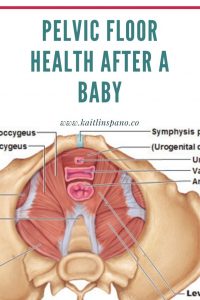
Everyone has a pelvic floor. Males AND females. This article however, we will focus on the female anatomy of the pelvic floor. Your pelvic floor muscles are the muscles that make up the area around your vagina and anus. If you make the shape of a triangle with your thumbs and index fingers and place it between your legs; that is your pelvic floor. It is responsible for controlling your bladder & bowel movements as well as supporting you the weight of your baby during pregnancy, birth and sexual pleasure.
What people do NOT realize is that your pelvic floor is connected to your inner most core muscles, the transverse abdominus(TVA). Which makes your pelvic floor part of your core, weird right? Shown below is a side visual of your pelvic floor and how it is connected to your TVA and how those muscles work together to support your breathing.
DID YOU KNOW YOUR TRANSVERSUS ABDOMINUS IS THE MUSCLE THAT ALLOWS YOU TO PUSH OUT YOUR BABY?
Why is your Pelvic Floor Important During Pregnancy & Postpartum?
Your pelvic floor is an important muscle during pregnancy and beyond because it is the base muscle of your core unit. Your core unit is made of your pelvic floor, transversus abdominus, diaphragm & the multifidus(see image above). Most individuals are not even aware what their pelvic floor is and the most shocking part, it is working to support your body 24 hours a day, 7 days a week!
Have you signed up for the Abs After Baby Challenge yet?
It provides SUPPORT, like a hammock for your bladder, colon, rectum, vagina, cervix and uterus. It provides STABILIZATION for your hips and core unit while working together with core unit to allow you to walk, run, jump, skip and MOVE. It provides MAINTENANCE and allows you to pee and poop when you need to and you do NOT need too. It also provides sexual sensation for you and your partner. As this PT therapists states, just as Goldilocks did not want her porridge too hot or too cold, you do not want a pelvic floor that is too tight or weak. Because all of those things we mentioned above are going to malfunction otherwise!
During pregnancy it supports the weight of the baby, during labor and birth it allows the baby to pass through. If your pelvic floor is too tight during this time it can lead to tears which increases recovery time during the postpartum period.
Check out this video or this post where I walk you through two steps to find your pelvic floor in order to restore your pelvic floor.
This post may contain affiliate links. If you make a purchase from one of the links I will make a small commission at no charge to you. Healthy Mom Happy Mom does not diagnose, treat, or give out any professional advice for any medical conditions.
NUTRITION TIPS FOR BREASTFEEDING & POSTPARTUM EXERCISE
After a woman has a baby, they for some reason want to know how soon they will be able to lose the weight, what actions they can take and how long will it be when they can fit back in those jeans. When it comes to exercise and breastfeeding, there are a few questions you probably want to know.
Many new moms think they have to diet by restricting calories in order to lose the baby weight. In reality this is not healthy for mom or baby; especially if you are breastfeeding. I’m going to provide the information you need to make milk for baby and lose the baby weight in a healthy way.
AND IT IS EASY! Start with these 5 tips:
- See a pelvic floor therapist beginning exercise-Ask your OB for a referral at your 6/8 week check up.
- Complete some sort of core restoration program (Think of it as rehab)
- Start slowly and gradually.
- Drink water, water water!
- Don’t compare yourself to what other ‘new moms’ are doing.
Following these 5 tips will ensure that you are taking time to rehab, make a milk supply for your baby and allow your body to adjust to changes.
READ MORE: TIPS FOR BREASTFEEDING MOMS
WILL EXERCISE AFFECT MY MILK SUPPLY?
Exercise will not affect your milk supply, studies have shown that moderate exercise does not affect breastfeeding moms milk supply. Let’s keep in mind that ‘way back when’ moms where doing quite strenuous work to keep the household running. Things such as churning butter, making bread, putting wood on the fire, taking care of cattle and chances are they breastfed their babies also.
In the year 2020, moms are still working, just a bit differently. Exercise makes us feel good and it is highly encouraged after we have a baby so that we can continue to feel good amidst the changes that have taken place. Moderate exercise is encouraged such as yoga, low impact weight lifting, Pilates, barre, biking, walking and swimming. High intensity exercises such as running, jumping, and kickboxing should be considered only after healing has taken place which can take up too 6 months or longer. Some things to keep in mind during this time:
- Wait until 6 weeks before beginning exercise
- If you had a cesarean wait time is typically 8 weeks.
- See a pelvic floor therapist beginning exercise
- Complete some sort of core restoration program (Think of it as rehab)
- Start slowly and gradually.
- Drink water, water water!
- Don’t compare yourself to what other ‘new moms’ are doing
CAN I LOSE WEIGHT WHILE BREASTFEEDING?
Yes you can lose weight while breastfeeding. Some women lose it faster, some it may take up to a year or longer to lose what was gained over those 10 months of pregnancy. As long as you are eating a well rounded healthy diet women will naturally lose the weight over time. Losing weight by dieting, restricting, taking fat loss pills or excessive exercise will not result in a healthy weight-loss and puts you the mother and your milk supply (if nursing) at high risk. So I advise you not to try or do any of those things.
IN CONCLUSION:
As you can see, returning to postpartum fitness has many different variables. Every pregnancy, every labor and delivery, every healing period is DIFFERENT for each mother.
The MAIN things that you must do regardless of your HOW your journey into the postpartum world went are:
- Get a referral to go see a pelvic floor physical therapist
- Find a program to restore your core
- Check to see (or ask your PT/OB if you have Diastasis Recti
- Focus on Nutrition and hydrating those first few months; (not dieting!) exercise will eventually come into play and your body will know when you are ready.
- And remember fitness will NOT affect your milk supply, as long as you are getting sleep, eating nutritious foods, and hydrating!
- Be sure to download this free safe core workout for pregnancy and postpartum; gentle enough to start anytime after 6 weeks!
References:
YOU MAY ALSO LIKE:



Leave a Reply